
Great games rarely begin with a lecture.
They do not ask players to complete a two-hour certification path before they are allowed to move, aim, explore, build, race, or compete.
Instead, the best games get players doing something meaningful almost immediately.
That is a useful challenge for customer education and onboarding teams.
Because in SaaS, especially in usage-based and AI-enabled products, the commercial goal is no longer simply to sell access. The goal is to help customers reach value quickly enough that usage becomes habitual, measurable, and expandable.
In other words, onboarding is not just a learning problem.
It is a time-to-value problem.
The “first match” problem
There was a game I played a while ago, Call of Duty: Mobile, which serves as a useful example. Its tutorial and onboarding experience were among the best I have seen for a game of its type.
Activision’s own getting-started guide explains that once the app is downloaded, the player can create a username through Facebook, email, or as a guest, and is then dropped straight into the tutorial. The tutorial teaches movement, camera control, picking up a weapon, aiming, firing, reloading, and using a scorestreak in context. [1]
That sequencing matters.
The game does not begin by explaining every map, weapon class, perk, mode, loadout, rank system, or competitive strategy.
It teaches the player enough to survive their first experience.
Then it builds from there.
This is where many customer onboarding programs fall down.
Instead of helping customers reach their first meaningful outcome, onboarding often starts with:
- a feature tour
- an architecture explanation
- a mandatory training module
- a long documentation pathway
- a product overview presentation
- a certification-style learning path before practical use
These things may all have a place. But if they come before the customer has experienced value, they can delay activation rather than accelerate it.
The question for customer education teams is simple:
What is the customer’s equivalent of getting into their first match?
For a data platform, it might be running the first successful query.
For an integration product, it might be connecting the first source.
For a developer tool, it might be making the first successful API call.
For an AI product, it might be generating, evaluating, or deploying the first useful output.
For a customer support platform, it might be resolving the first real ticket.
That moment is not just a task. It is the first proof that the product can help the customer do something they care about.
Why time-to-value matters more now
Time-to-value has always mattered. But it matters even more in a world where software pricing is increasingly tied to consumption, usage, credits, tokens, compute, actions, or outcomes.
Usage-based pricing means customers pay according to how much they use a product, ideally through a metric connected to how they extract value. OpenView describes usage-based pricing as increasingly common in SaaS and notes that it changes the relationship between access, adoption, and expansion. [2]
AI is accelerating that shift. Usage-based models are becoming more relevant because AI products often have variable infrastructure costs and non-human usage patterns. Tokens, credits, compute units, API calls, and agent actions are becoming common pricing units. [3] [4]
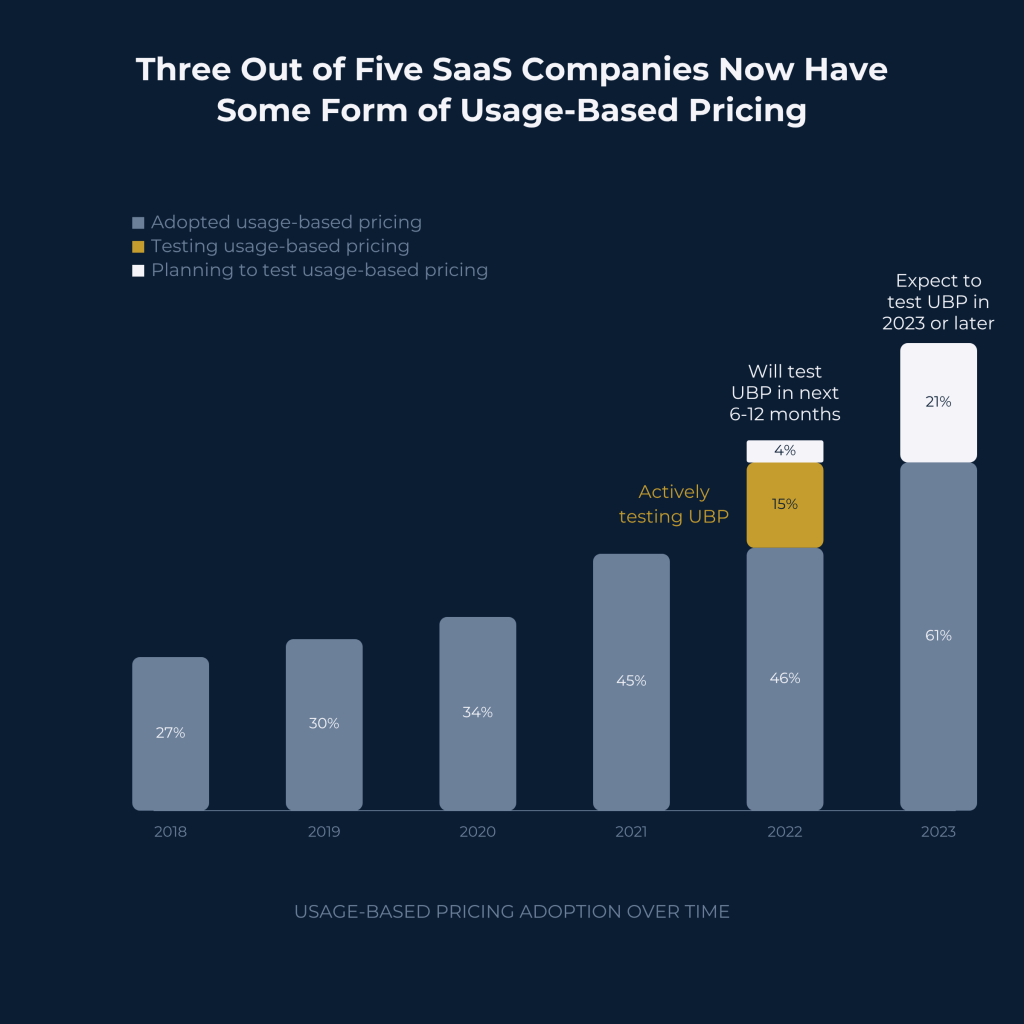
Recreated using data from OpenView Venture Partners [2]
This changes the role of onboarding.
In a traditional seat-based model, a customer might buy licences and underuse them for months. That is still bad for retention, but revenue may be protected in the short term.
In a usage-based or hybrid model, underuse is more directly connected to revenue. If customers do not use the product, they do not expand. If they do not expand, the account does not grow. If they do not reach value, they churn or remain marginal.
So onboarding can no longer be treated as a post-sale formality.
It becomes part of the revenue system.
Good onboarding reduces the time between purchase and proof.
Customer education then extends that proof into repeatable usage, broader adoption, and eventually mastery.
The evidence: early value predicts later retention
The strongest reason to care about time-to-value is not aesthetic. It is behavioural.
Amplitude’s 2025 Product Benchmark analysis found that products delivering value in the first week saw materially better long-term outcomes. In its data, 69% of products with strong early activation were also strong three-month retention performers. The same analysis found a large gap between top and median products at three months, with top products retaining 18.5% of users compared with 3.8% for median products. [5]
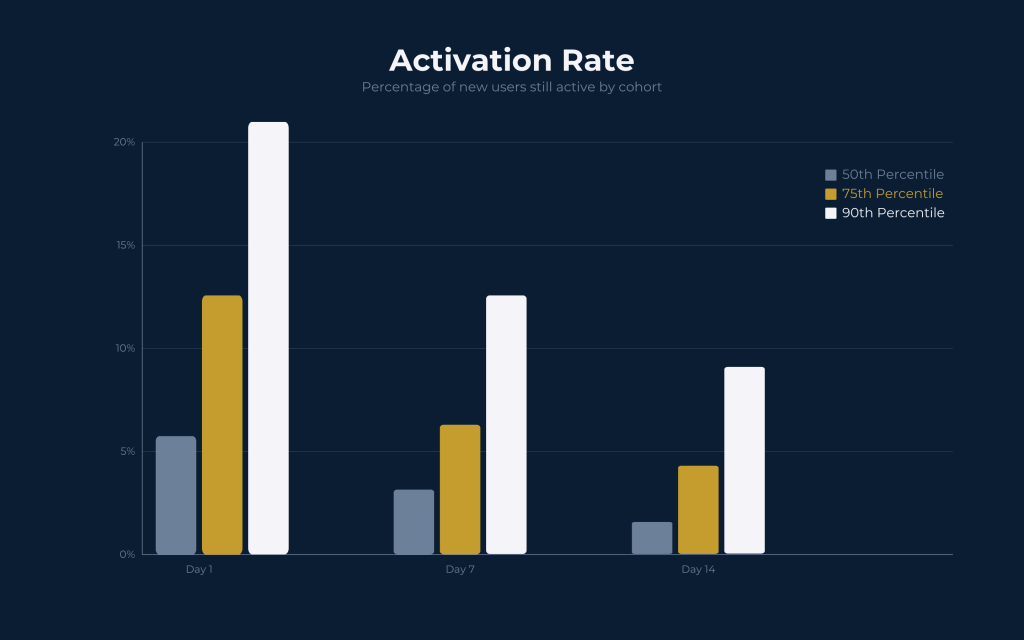
Recreated using data from Amplitude [5]
The exact numbers will vary by product type, audience, and market. But the pattern is consistent with what customer education teams already see in practice:
- Customers who reach value quickly are easier to retain.
- Customers who do not reach value quickly require more hand-holding, create more support demand, and are less likely to expand.
This does not mean onboarding should be shallow. It means the first stage of onboarding should be deliberately narrow.
The goal is not to teach everything.
The goal is to help the customer succeed at the first thing that matters.
What games understand about onboarding
Video games are unusually good at onboarding because they have to be.
A player can abandon a free-to-play game within minutes. There is little switching cost, little patience, and little tolerance for friction. Game developers therefore obsess over the first-time user experience (FTUE).
GameAnalytics argues that the first moments after a player downloads a free-to-play game are critical, and that users should be doing something fun as soon as they open the game. [6]
This principle translates directly to SaaS: Customers should be doing something valuable as soon as possible.
Not reading about value.
Not being told about value.
Experiencing value.
Several game tutorial techniques are especially useful for customer education and onboarding.
1. Start with action, not theory
Good games rarely start with a rulebook.
They teach movement by asking you to move. They teach aiming by asking you to aim. They teach interaction by putting an object in front of you.
Customer onboarding can do the same.
Instead of starting with a platform overview, start with a meaningful workflow.
For example:
- “Invite your first teammate.”
- “Create your first dashboard.”
- “Connect your first data source.”
- “Send your first test API request.”
- “Resolve your first support case.”
- “Generate your first AI-assisted response.”
Theory should support the action, not delay it.
2. Teach one mechanic at a time
Games rarely introduce every system at once.
A tutorial might teach movement first, then camera control, then aiming, then reloading, then special abilities. The player is not expected to understand the full system before interacting with it.
This is progressive disclosure in practice.
Nielsen Norman Group (NN/g) defines progressive disclosure as deferring advanced or rarely used features so users initially see only the most important options. This makes applications easier to learn and less error-prone. [7]
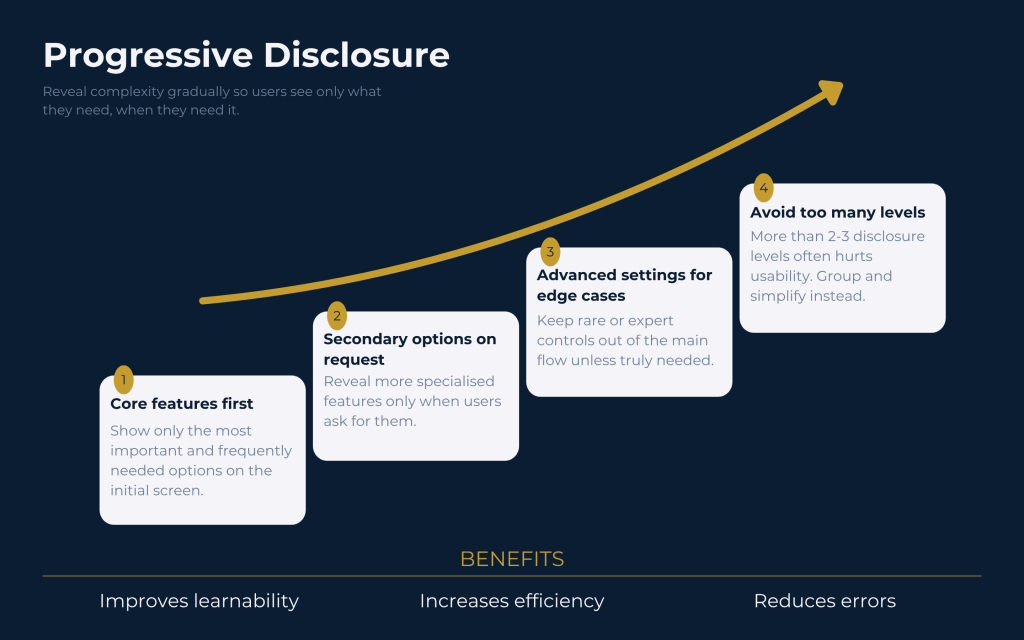
Progressive disclosure as defined by NN/g [7]
Customer education teams can apply the same principle by sequencing learning around the customer journey:
- First, teach the minimum viable workflow.
- Then, introduce configuration.
- Then, introduce collaboration.
- Then, introduce governance.
- Then, introduce optimisation.
- Then, introduce advanced use cases.
The mistake is trying to prove the product’s power through all its features too early.
Power is only useful once the customer has enough context to use it.
3. Provide immediate feedback
Games are feedback machines.
You know when you hit the target. You know when you complete the objective. You know when you gain XP, unlock an item, fail a mission, or move to the next level.
Many onboarding programs do not provide this clarity.
A customer may attend training, read documentation, or complete a setup step without knowing whether they are actually closer to value.
Good onboarding should make progress visible.
For example:
- “Your first source is connected.”
- “Your model has run successfully.”
- “Your dashboard has been shared.”
- “Your first workflow has completed.”
- “Your first automated action has been triggered.”
- “Your team has reached the activation milestone.”
Feedback turns onboarding from passive instruction into guided progress.
4. Create safe failure
Games allow players to fail in low-risk environments.
You can miss a shot, fall off a platform, restart a mission, or lose a training round without damaging your real progress.
SaaS onboarding should create similar safety.
This is especially important for technical, data, AI, security, infrastructure, and business-critical products.
Customers need places where they can try, break, reset, and repeat without risk.
That might look like:
- guided labs
- sample data
- test workspaces
- disposable projects
- simulated workflows
- sandbox environments
- “practice mode” templates
Safe failure is not just a nice learning feature. It reduces anxiety, increases experimentation, and helps users build confidence before moving into production.
5. Build towards mastery, not completion
A weak onboarding program asks:
Did the customer complete the training?
A stronger onboarding program asks:
Can the customer now do the thing they bought the product to do?
Games understand this distinction.
Completing the tutorial is not the point. The tutorial exists to prepare the player for the game.
Customer education should work the same way.
The goal is not course completion, webinar attendance, or documentation views.
The goal is capability.
That means customer education should be measured against outcomes such as:
- repeat usage
- activation rate
- feature adoption
- time to first value
- customer maturity
- renewal confidence
- expansion readiness
- support ticket reduction
- time to first production use case
Education activity matters only insofar as it changes customer behaviour.
What a video-game-inspired onboarding program could look like
A game-inspired onboarding program does not mean adding superficial badges or turning enterprise software into a toy.
It means designing a structured path from first action to confident adoption.
Here is one possible model.
Level 0: Remove friction
Before teaching anything, remove unnecessary barriers.
- Offer templates.
- Make sign-in simple.
- Provide sample data.
- Create sandbox access.
- Use SSO where appropriate.
- Avoid forcing unnecessary setup before the first useful action.
The goal is to reduce the distance between curiosity and action.
Level 1: First mission
Design one guided workflow that leads to a meaningful outcome.
This should be narrow, specific, and achievable quickly.
For example:
- “Build your first report.”
- “Deploy your first integration.”
- “Create your first AI workflow.”
- “Run your first transformation.”
- “Resolve your first customer query.”
This is the customer’s first match.
Level 2: First win
Make success visible.
Show the customer what they achieved, why it matters, and what to do next.
This could include:
- a success screen
- a usage milestone
- a progress checklist
- a short reflection prompt
- a recommended next step
- a comparison with the original business goal
The customer should not have to infer value. The onboarding experience should make value explicit.
Level 3: Guided repetition
One success is not adoption.
The customer now needs to repeat the workflow with their own data, team, users, or business process.
This is where customer education can move from generic onboarding into role-based enablement.
For example:
- admin path
- partner path
- developer path
- practitioner path
- business user path
- executive sponsor path
Each role should have a different “next mission”.
Level 4: Unlock complexity
Only after the customer has achieved the core workflow should you introduce advanced features.
This might include:
- security
- automation
- governance
- integrations
- optimisation
- AI evaluation
- custom workflows
- advanced analytics
- scale and performance
The principle is simple:
Do not teach advanced mechanics before the customer has mastered the basic controls.
Level 5: Mastery and expansion
Finally, customer education should support long-term maturity.
This is where academies, certifications, communities, champion programs, office hours, advanced workshops, and partner enablement become valuable.
But these should not be confused with initial onboarding.
Initial onboarding gets the customer to first value.
Customer education helps the customer keep expanding value over time.
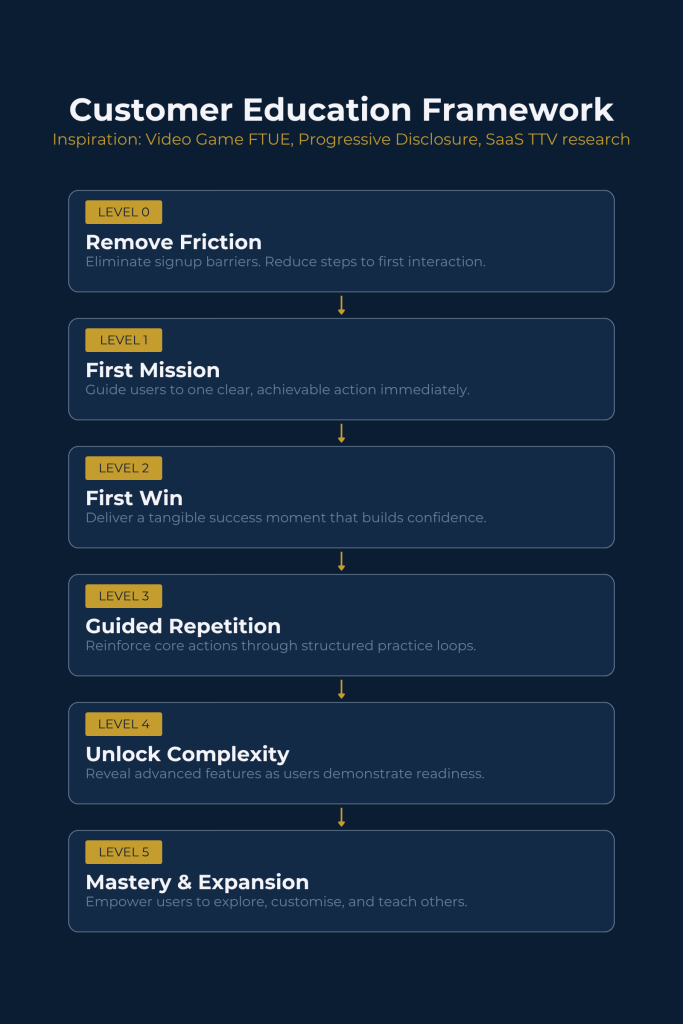
Framework informed by video game FTUE design, progressive disclosure and SaaS TTV research
The translation table
| Video game tutorial principle | Customer onboarding equivalent |
|---|---|
| Get the player into the first match quickly | Get the customer to their first meaningful workflow quickly |
| Teach controls through action | Teach product concepts through hands-on tasks |
| Introduce one mechanic at a time | Use progressive disclosure |
| Provide instant feedback | Show success states, milestones, and progress |
| Let players fail safely | Use sandboxes, labs, templates, and sample data |
| Unlock complexity gradually | Sequence advanced features after core activation |
| Reward mastery | Build maturity paths, certifications, and champion programs |
Table created based on inspiration from Activision [1], Amplitude [5], GameAnalytics [6], and NN/g [7]
What not to copy from games
The lesson is not “add points and badges to everything”.
Gamification can become shallow very quickly.
Enterprise customers do not need artificial rewards for completing meaningless tasks. They need clear progress towards business outcomes.
So the useful lesson from games is not decoration.
It is design discipline.
Games are good at answering:
- What does the user need to do first?
- What can wait until later?
- Where might they get stuck?
- What does success look like?
- What feedback do they need?
- How do we make progress visible?
- How do we keep them engaged after the first win?
Those are the same questions customer education teams should be asking.
A practical checklist for customer education teams
If you are designing or improving an onboarding program, start with these questions:
- What is the customer’s first meaningful outcome?
- How quickly can a new customer reach it today?
- Which steps delay value without increasing confidence?
- Which concepts are being taught too early?
- Where can we replace explanation with action?
- What feedback tells the customer they are succeeding?
- Where can customers safely practise before production?
- What should be unlocked only after first value?
- Which metrics show behaviour change rather than content consumption?
- How does onboarding connect to adoption, retention, and expansion?
Closing thoughts
The best video game tutorials do not ask players to understand the entire game before they play.
They help players win their first round.
Customer onboarding should do the same.
Not because customers need entertainment.
But because they need momentum.
In a world where revenue increasingly depends on usage, consumption, and realised value, customer education has to move closer to the product experience.
The most effective onboarding programs will not be the ones with the most content.
They will be the ones that help customers reach value sooner, build confidence faster, and keep progressing long after the first session ends.
So the question for every SaaS team is:
What is your customer’s “first match” moment, and how quickly can you get them there?
References and additional reading
[1] Call of Duty: Mobile onboarding example — Activision says users can create a username via Facebook, email, or guest access and are then dropped straight into the tutorial, where they learn movement, camera control, weapon pickup, aiming, firing, reloading, and scorestreak basics. https://blog.activision.com/de/call-of-duty/2019-09/Call-of-Duty-Mobile-Boot-Camp-Part-1-Getting-Started-in-the-Game
[2] Usage-based pricing definition and SaaS relevance — OpenView defines usage-based pricing as customers paying according to how much they use a product, with the usage metric connected to how customers extract value. It also notes that usage-based pricing is becoming more prevalent in SaaS. https://openviewpartners.com/usage-based-pricing/
[3] AI and usage-based pricing adoption — Metronome’s 2025 report says 64% of surveyed companies use usage-based pricing, 78% of companies with UBP adopted it within the last five years, and AI has intensified the need for flexible pricing because of variable usage and infrastructure costs. https://metronome.com/state-of-usage-based-pricing-2025
[4] Tokens, agent actions, and SaaS value metrics — Stripe’s 2026 guide states that usage-based SaaS pricing includes AI APIs charging per token and lists API calls, records processed, agent actions completed, and tokens consumed as common strong metrics. https://stripe.com/resources/more/usage-based-pricing-strategy-for-saas
[5] Time-to-value and retention evidence — Amplitude’s 2025 benchmark analysis links early activation to later retention, including the 69% figure and the top-vs-median three-month retention gap of 18.5% vs 3.8%. https://amplitude.com/blog/time-to-value-drives-user-retention
[6] Game FTUE principle — GameAnalytics argues that the first moments after a player downloads a free-to-play game are critical and that users should do something fun as soon as they open the game. https://www.gameanalytics.com/blog/tips-for-a-great-first-time-user-experience-ftue-in-f2p-games
[7] Progressive disclosure — Nielsen Norman Group defines progressive disclosure as showing users only the most important options initially and deferring advanced or specialised options until later. https://www.nngroup.com/articles/progressive-disclosure/
[8] Customer education business impact — Intellum’s commissioned Forrester study reported that companies with formalised customer education programs saw average improvements including 7.6% top-line revenue lift, 38.3% product adoption increase, 35% increase in average lifetime value per trainee, and 15.5% decrease in support costs. Treat this as vendor-commissioned research, useful but not neutral. https://www.intellum.com/news/research-impact-of-customer-education-programs
[9] Activation and PLG metrics — ProductLed frames activation around getting users to an “aha” moment and tracking/reducing time-to-value. https://productled.com/blog/product-led-growth-metrics
[10] Game onboarding and cognitive load — Celia Hodent’s GDC material argues that onboarding must manage attention, reduce cognitive overload, remove barriers, and use active tutorials because learning by doing is especially effective in interactive experiences. https://celiahodent.com/gamers-brain-ux-onboarding/


Leave a Reply